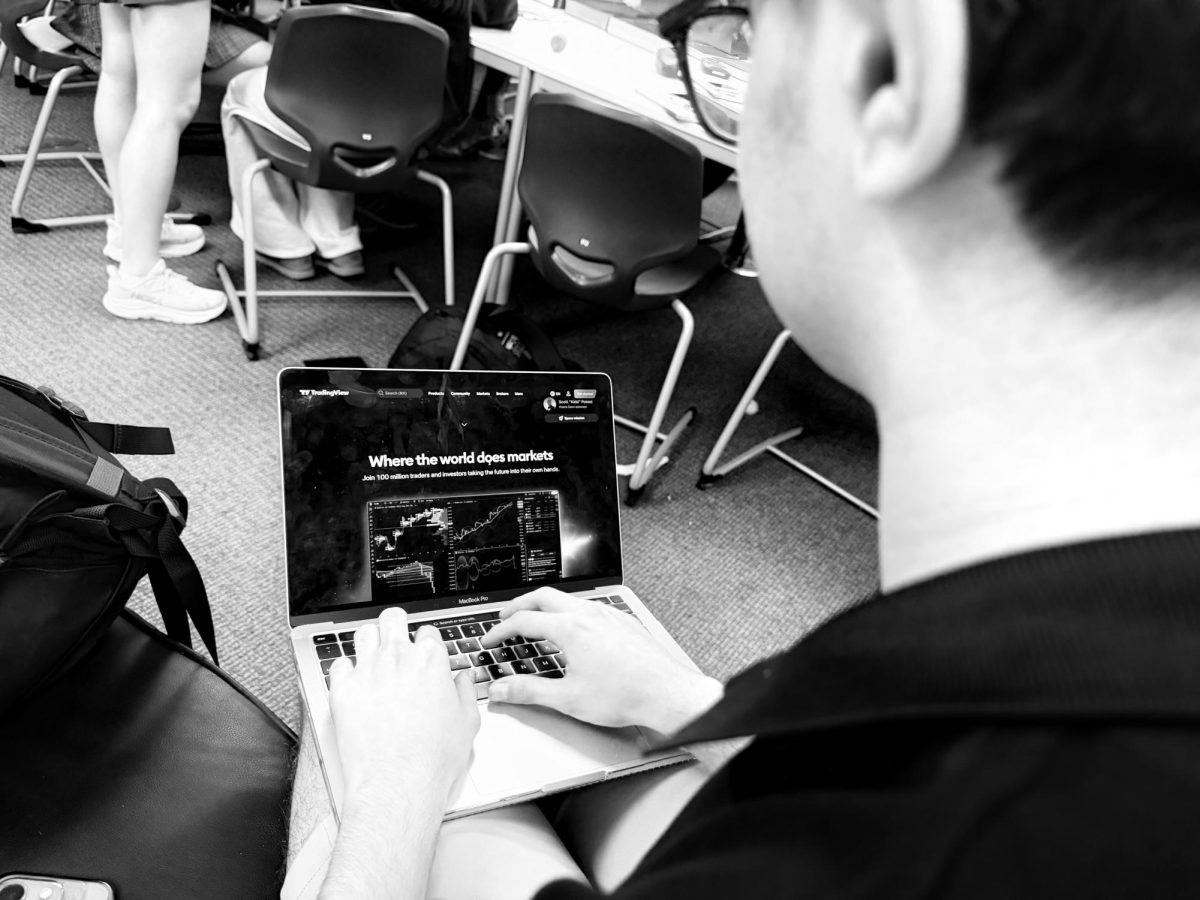
While some students enjoy hobbies like video games, books or sports, members of the Business Competition Club choose to spend their time glued to a computer, participating in the global phenomenon known as day trading.
Day trading involves buying and selling stocks, usually within the same day, to profit from small price movements. Eventually, the market closes to eliminate overnight risk and force traders to stick to daily strategies.
Day trading and gambling are becoming staples of modern technology, and many notice numerous similarities between the two. Junior AJ Alagarsamy and vice president of the Business Competition Club compares day trading to gambling.
“It taps into the gambling mindset,” Alagarsamy said.
Despite these disadvantages, many teenagers and young adults involve themselves in day trading due to its popularity on social media. Apps like Instagram, Reddit and TikTok encourage many day traders to continue buying stocks even when they have already lost large amounts of money.
Alagarsamy says that social media “glamorizes” day trading in a way that downplays the risks. He recommends traders to not follow social media platforms for advice.
“If you’re looking for high quality trading advice, I’d look at academic journals, Bloomberg reports or other paid financial news sources,” Alagarsamy said. “It’s a much better way to learn about those things than social media.”
With the sudden spike in day trading, many teenagers participate without understanding the financial skills needed.
“They think by winning one day, that means you’re going to win in the future,” Alagarsamy said. “Past performance doesn’t indicate future results.”
Upper School history teacher Eleanor Cannon, who teaches the Economics elective, touches on this risk-taking facade of day trading.
“It convinces traders that they’ve got it right and it encourages more risk taking,” Cannon said. “The universe isn’t speaking to them via stocks.”
Ninety-seven percent of day traders lose money on any given day, yet this statistic does not discourage participation. Alagarsamy notes the resemblance of day trading to modern betting technologies, such as sports betting, online casino apps and poker, which heightens its appeal to St. John’s students who already like gambling.
“Many people think just because they’re smart and able to make patterns they can trade well, but often that’s untrue,” Alagarsamy said.
As a leader in the Business Competition Club, Alagarsamy finds it challenging to balance encouraging financial curiosity while discouraging reckless risk-taking, especially since the competitions that members of his club participate in are less centered around day trading, and more focused on long-term trading.
Parents see day trading as a temporary trend. Alagarsamy disagrees, labeling it as a shift in how people participate in online markets and trading.
“Day trading will continue to remain as a practice, as some people make money, and some lose it,” Alagarsamy said.
Looking into the future, Alagarsamy predicts day trading will continue to remain popular, while AI algorithms will make it harder for traders to succeed at the same time. With this, Alagarsamy gives advice to excited and anxious day traders.
“Day trading is inherently extremely risky and very similar to gambling,” Alagarsamy said. “If you’re looking at it as something you’re trying to get better at, I don’t know if that’s the right path.”
Cannon is concerned about Polymarket, an American digital prediction market that was banned by the United States in 2022 before entering the public domain again in late 2025. Polymarket enables citizens to bet on anything, including sports and elections, in a day trading format.
“What’s interesting about Polymarket is the impact it can have on political outcomes,” Cannon said. “News outlets are carrying Polymarket lines on voting, so I worry that’s a democracy topic.”
Cannon is alarmed that in the future, these easily seen lines can have an effect on political elections. She hopes that there can be more restrictions on these companies to allow for fairer decisions. Cannon gives advice to those willing and brave enough to start the endeavor:
“Day trading is more risky than you think, but you can mitigate the risk with information and guidance,” Cannon said.