On a quiet stretch of summer before freshman year began, two middle schoolers found themselves returning to the same conversation during lunch: philosophy, ethics, politics and the kinds of questions that do not fit neatly into everyday small talk.
Today they are sophomores Aris Hanna and Beau Blanton. What started as casual debate between friends at their lunch table slowly took on a more ambitious shape: What if there was a place at school where students could discuss difficult issues openly and respectfully with people who disagreed?
“Beau and I were looking for a place and a way to talk about controversial topics with one another,” Hanna explained. “Since we were both going to St. John’s and we knew of the vibrant club culture, we thought we would just create a think tank for philosophy and ethics.”
That idea evolved into what is now known as the Open Discourse Education Club, a space created to provide structured, civil conversations to the student body.
Officially launched in September, the club now draws dozens of students to its meetings and has quickly carved out a unique role in campus life.
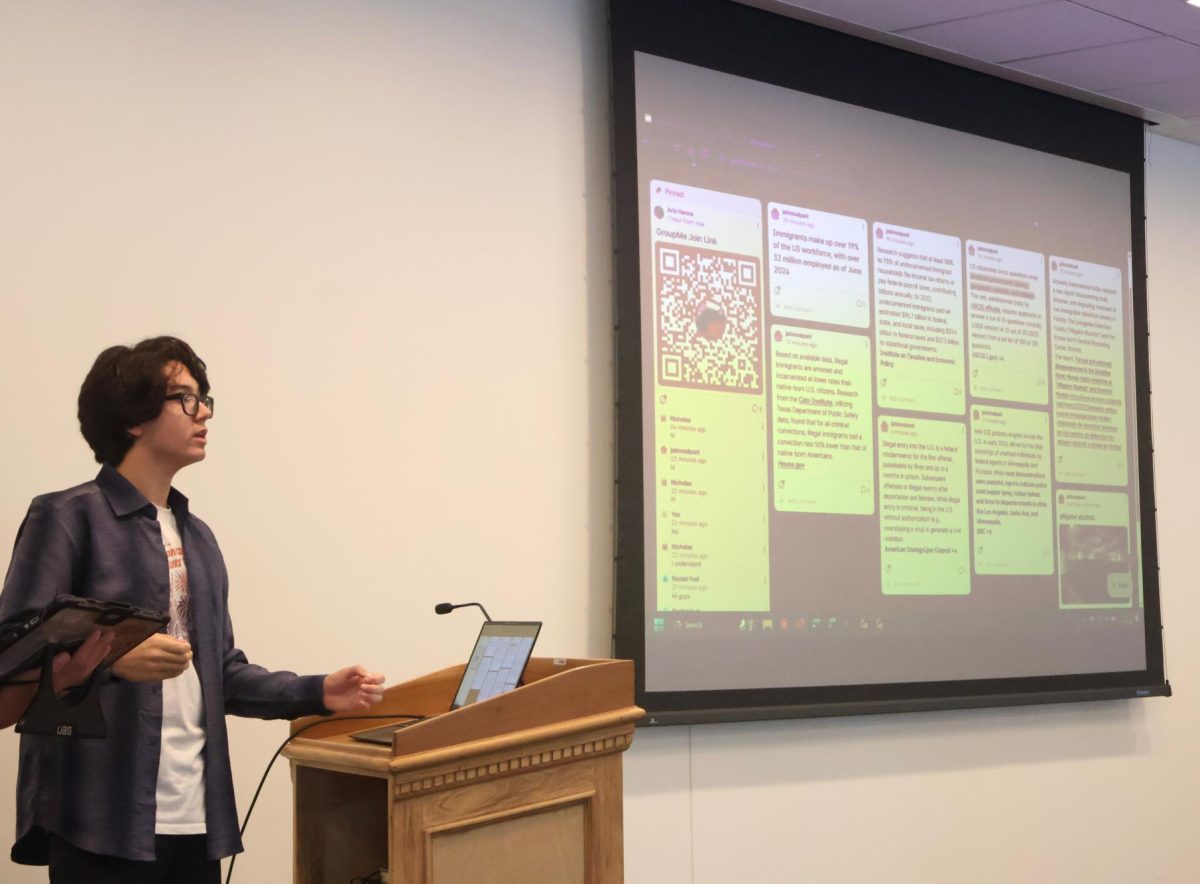
“Our mission is to provide a safe space to promote civil discourse between the students here at St. John’s,” founder and president Hanna said.
However, when they arrived on campus, they realized there wasn’t a consistent, discussion-based platform for political dialogue. Although other organizations addressed civil topics, the founders felt those spaces were either lecture-oriented or too infrequent to build sustained conversation.
“We decided that we needed a more effective, more consistent, more active way for students to express their opinions, other than listening to lectures and not being able to speak,” Hanna said.
Blanton emphasized that the club’s goal is not to promote any single viewpoint but to bring different perspectives together.
“We want to bridge the gap in discourse between both ends of the political spectrum,” Blanton said. “We think this club is a really great way to do that.”
That emphasis on dialogue rather than pure debate is central to ODEC’s identity. Meetings are structured as moderated discussions, encouraging students to respond directly to one another rather than simply state positions and move on.
Faculty sponsor David Castillo said that approach is what convinced him to support the club.
“What this club is doing is facilitating proper discourse: a back-and-forth discussion that can actually make progress in people’s opinions, interpretations and perceptions,” Castillo said. “And that’s fundamentally important to our society right now.”
Castillo serves as what he describes as a largely hands-off sponsor, allowing students to lead while ensuring conversations maintain high standards.
“It’s going to be very important that the club has ground rules about norms, about how to discuss things and how to respect each other,” he said, emphasizing that inclusivity and rigor must go hand-in-hand.
Another aspect that stands out to Castillo is student ownership.
“The sponsors aren’t doing it,” he said. “This is the students. And it’s clear that it means a lot to them.”
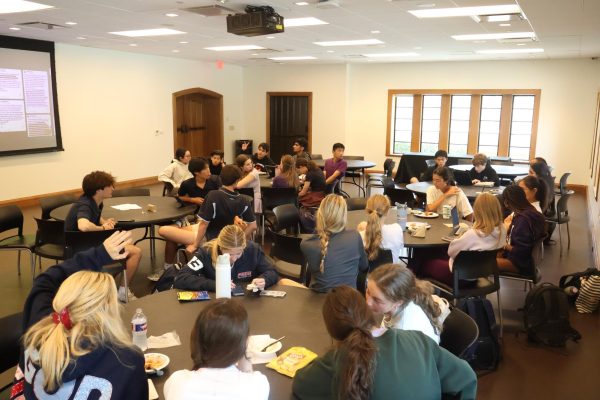
That structure has already been tested. Smaller meetings are typically held in Castillo’s classroom, where students sometimes explore lighter or less emotionally charged topics. Larger forums, including a recent discussion on gun policy, have taken place in the atrium.
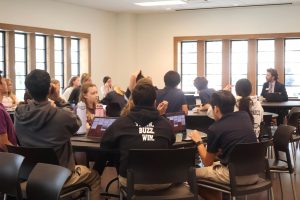
“At the gun policy meeting, we ended up with a turnout of 55 people,” Blanton said. “Most of them weren’t even club members, just people who decided to walk in.”
The club has also taken a close interest in how discussions are conducted, given the sensitive nature of many topics.
“Our biggest concern is students being ostracized because of their beliefs,” Hanna said. “So we have a large policy infrastructure to prevent that from happening.”
Those policies aim to ensure conversations remain structured, respectful and inclusive.
ODEC operates on a biweekly schedule, with major events roughly once or twice a month. Hanna and Blanton manage meetings, while sophomore and correspondence manager Will Byers manages logistics such as scheduling, emails and planning.
Interestingly, ODEC was not approved on the first attempt. The founders originally tried to establish the club during their freshman year in 2024, but were asked to clarify how it differed from the Student Political Education Club: an existing club that also analyzes political and social issues.
After observing SPEC more closely, they refined their vision.
“SPEC is more lecture-based and informative,” Hanna said. “But what we’re going for is more discussion-based and cooperative.”
That distinction has become central to ODEC’s appeal. Rather than presentations or debates with winners or losers, meetings are designed as open forums where students can explore ideas and hear opposing viewpoints in a structured environment.
ODEC’s rapid growth suggests that the founders tapped into a genuine need on campus: a place where students can wrestle with difficult questions together rather than avoid them.
As Hanna and his team continue to redefine the club’s format and expand participation, one thing remains clear: ODEC is not just another extracurricular activity.
“It is an experiment in how students can disagree thoughtfully, listen seriously and engage with the world beyond the classroom; one conversation at a time,” Hanna said.