While most students spend their weekends catching up on sleep or finishing homework, sophomore John Brandt Gerdes heads toward the water. At the Lakewood Yacht Club in Seabrook, he adjusts sails with the wind.
Gerdes has spent nearly 10 years of his life on the water perfecting the art of sailing. He is a nationally ranked sailor. Sophomore Ansel Brinkley, a lifelong friend of Gerdes, has seen the level of commitment required.
“He is sailing every weekend,” Brinkley said. “Half the time he cannot come to hang out because he has been on the water all day or has work to catch up on.”
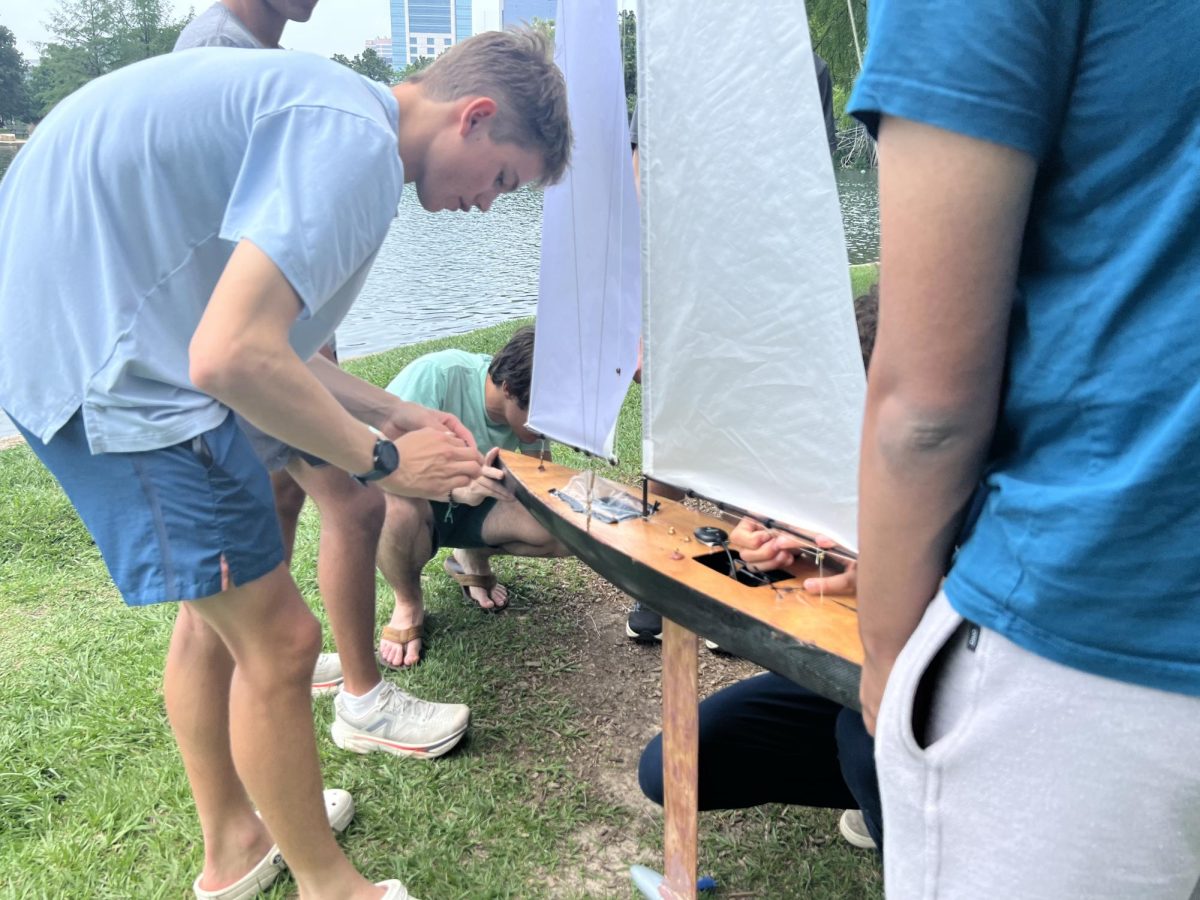
Gerdes has taken on a new sailing-related project, for which he never actually has to get on a boat. Alongside Brinkley, Gerdes is pioneering Mav Sail Robotics: a project that aims to create a fully autonomous miniature boat by seamlessly integrating sailing and robotics. Their project requires them to think about concepts like Velocity Made Good, which is a sailing term used to describe the speed at which a boat makes progress towards a specific point.
“On a traditional boat, you would be able to feel what the boat feels and adjust based on instinct.” Gerdes said. “With the sailboat, those instincts are replaced by math to find the most efficient VMG and nautical route.”
Together with Gerdes’s deep understanding of physics and with the engineering expertise of Brinkley, they are constructing a craft that relies on artificial intelligence rather than human hands. They aim to eventually compete on a collegiate level next to prominent universities at the 18th annual Robotic Sailing Regatta hosted at Cornell University.
The partnership between Gerdes and Brinkley defines the project. Gerdes focuses on sailing mechanics and physics, while Brinkley leads the engineering and programming.
“It is pretty straightforward,” Brinkley said. “It is a 50/50 split.”
The engineering behind the sailboat is complex. To optimize performance, the team utilized the National Advisory Committee for Aeronautics’ airfoil formula to determine the precise curvature of the sails. Unlike traditional sails, they are designed to function like wings, generating lift to propel the craft forward.
Brinkley has arranged an engineering team of over five workers dedicated to the internal workings of the boat. The team recently finished the “heart” of the ship – an NVIDIA supercomputer, which processes data from cameras and Light Detection and Ranging sensors to navigate the boat. This brain-like command center communicates with a flight controller, a device typically reserved for drones, to manage the servos and motors, allowing the boat to steer and adjust its sails without human input.
Sophomore Bennett Thomas, who is part of the engineering team, views this flight controller as essential to the functioning of the boat, since it has a built-in GPS which prompts the boat to follow pre-designated routes. Yet getting these systems to work together has proven difficult. The flight controller’s GPS cannot account for obstacles in the water– something that the AI that Thomas is developing needs to accomplish.
“The hardest part right now is getting the AI to talk to the flight controller,” Thomas said. “Individually, everything works. It is just getting them to work together consistently.”
One of the most innovative features of the sailboat is the sail drum line, a loop of wire running beneath the deck that syncs all the motors together.
Once the boat enters the competition, the team cannot intervene. The system must navigate shifting buoys, changing wind conditions and nearby boats entirely on its own.
“The frustrating part is you cannot fix anything once it is out there,” Brinkley said. “You just have to see if what you built actually works.”
The team plans to enter their creation into competitions where they will face university-level opponents. Despite the age gap, the team feels their agility and communication give them an advantage.
“We aren’t just a group of people working on separate portions,” Gerdes said. “All the people on MavSail, the mechanical software, and electronics teams, we all work together and overlap, we solve problems faster than a massive university department might, because they simply lack the same camaraderie that we have.”