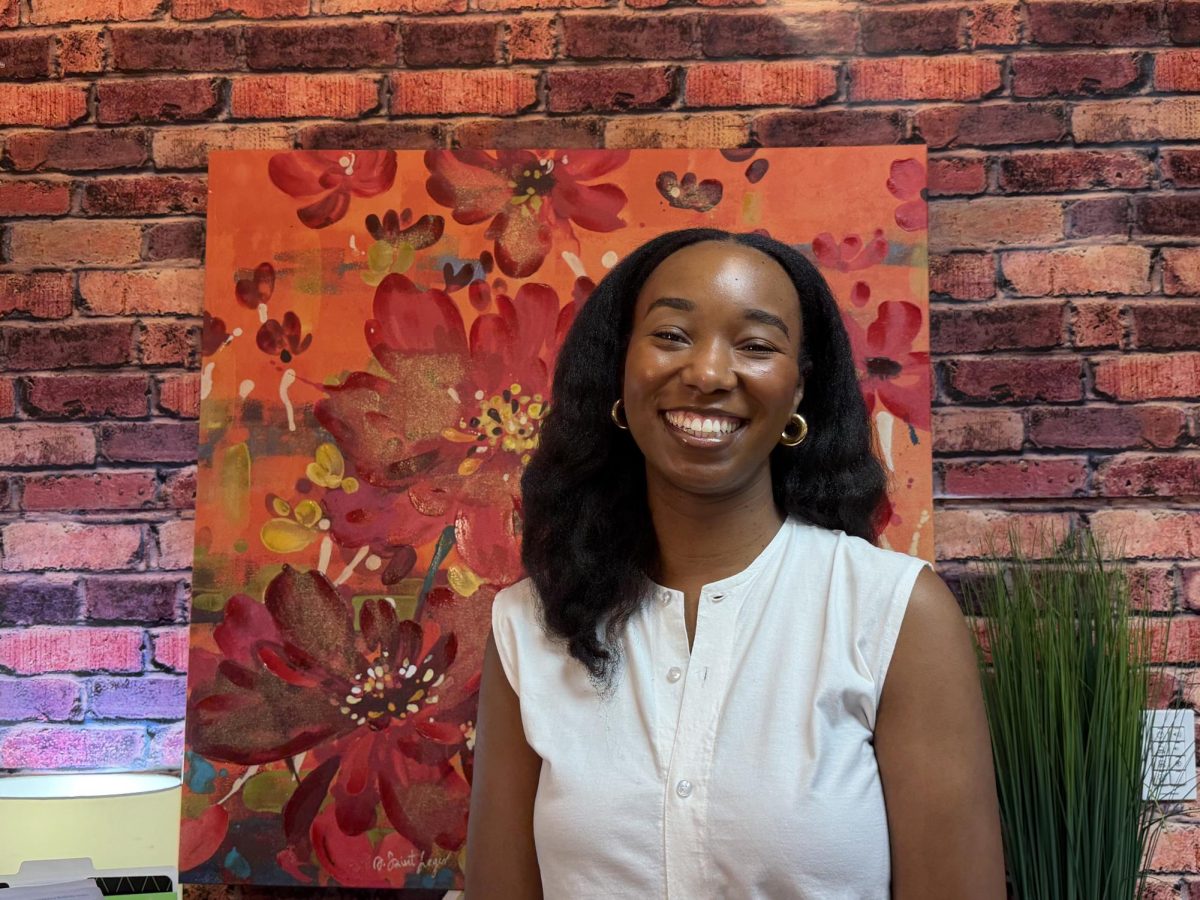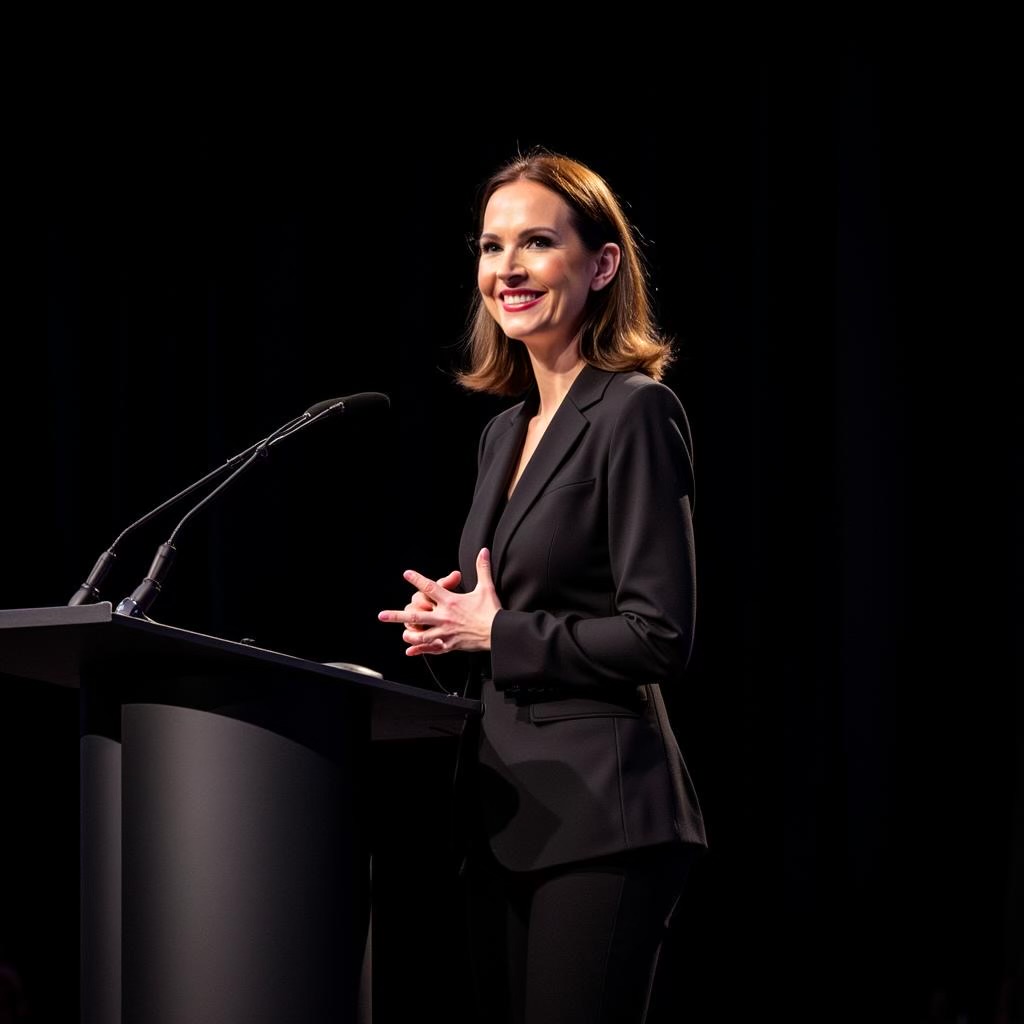

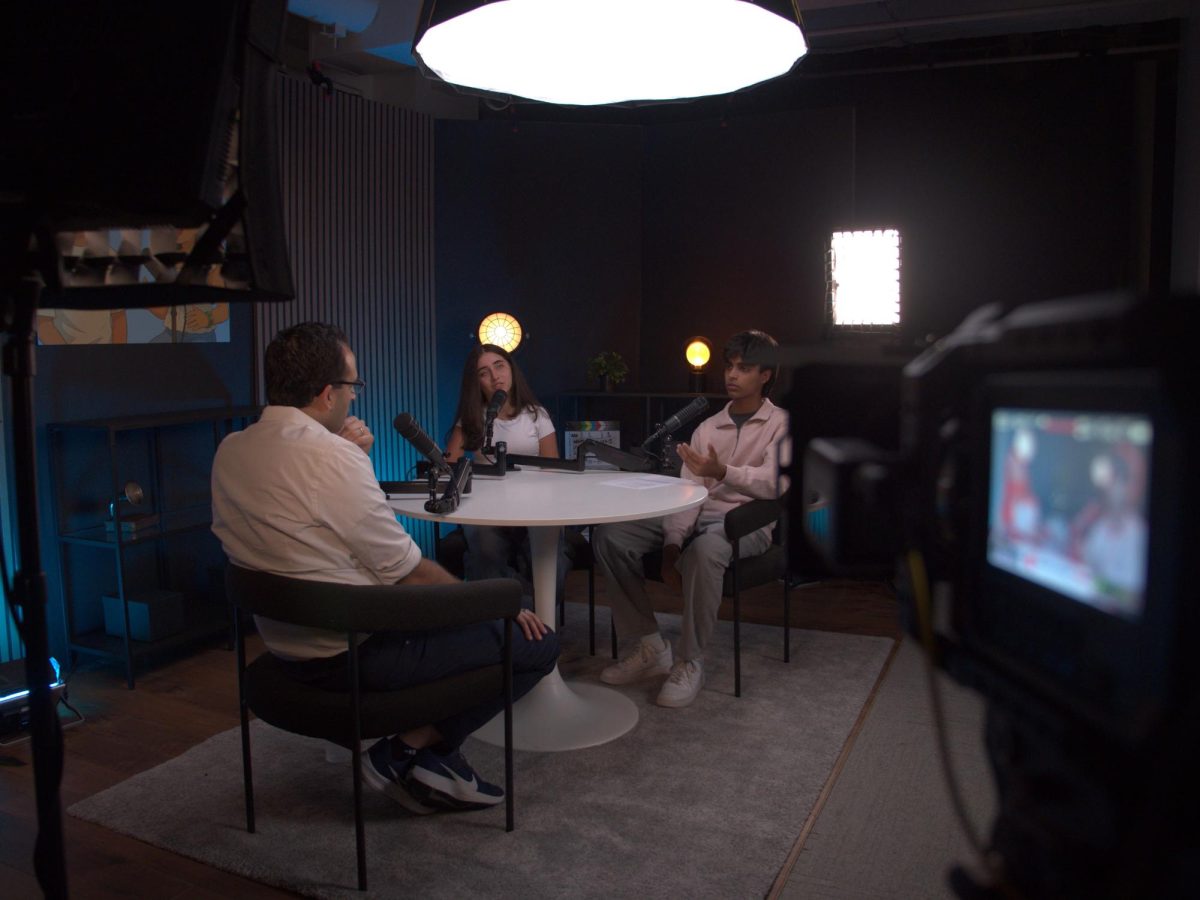
Ashna Bhagia would not hesitate to give a speech in front of her grade, yet her first time behind the podcast mic left her nervous and stuttering.
“Even though I love talking to people and I love public speaking as well, it definitely was a little intimidating to be in a room, sit down and then start talking and asking a bunch of questions,” freshman Bhagia said.
Over the summer of 2025, Bhagia and her friend Saahib Sarai, an Awty sophomore, started a video podcast called The Next Gen Lens. The duo recorded their first season in Speaker Box Studios, where they learned the ropes of the trade from experienced podcasters.
Bhagia and Sarai use The Next Gen Lens as a platform “where young voices explore big questions.” Guests on the podcast have included Upper School golf coach and history teacher Joseph Soliman to talk about balancing high school sports and academics. They also invited dermatologist Anita Mehta to discuss adolescent skin care, and start-up founder Raj Salhotra (‘09) to talk about the Indian American teenage experience.
“If you’re a teen who’s passionate about something, having a podcast is a great way to put yourself out there and you’ll also be more comfortable talking about that thing and gain more experience,” Bhagia said. “If you’re looking to improve your speaking or you have something that you want to talk about and you’re not sure how to get it out to people, I do think it’s definitely very helpful to start a podcast.”
The podcast industry has enjoyed immense success and popularity in recent years. Half of Americans listened to a podcast in 2023, and younger Americans from ages 18 through 29 are much more likely to listen to podcasts than older Americans. The only new category introduced by the Golden Globes Awards ceremony this year was for podcasts (Amy Poehler’s The Good Hang took home the prize).
For their second season, Bhagia and Sarai recorded their podcast at Sarai’s house instead of in the studio.
“A lot of our guests came to the studio and they were not expecting all the cameras and lights. That put them on edge a little bit,” Bhagia said. “If you have a setup like on your couch at home and you have a couple mics, it might feel like more of a welcoming environment.”
Podcasting has also broken out in the School’s curriculum. Upper School English teachers Edward Young and Matthew Wells created a Jan Plan course called Intro to Podcasting: Audio, Storytelling, and Production. They taught students how to tell stories effectively using podcasts and how to produce podcasts with editing software. Young’s inspiration came from his experience as a student in a podcasting workshop. He wanted to give students the opportunity to explore their interests through a different form of digital media.
“That’s what I loved about the class: the students were able to bring their expertise and knowledge and what I was really just giving them were things that I feel competent in, which is storytelling and structuring a narrative,” Young said.
Podcasts produced in the class covered advertising culture, in particular with Labubus versus Lafufus and Juuls versus vapes, food reviews and advancements in technology. Young was a Speech and Debate coach at his previous school, and appreciates that podcasting gives students a platform to broadcast their ideas.
“Learning to have that confidence in your voice and have that awareness of the power of your voice is really important,” Young said. “We all kind of cringe when we hear our voice through a video or a tape recording, but becoming not just comfortable with the sound of your voice, but also the power of your ability to craft a narrative, is what I hope students took away.”
Young notes that the podcasting industry is egalitarian.
“If you’re interested in something, you can create a podcast and put it out there,” he said. “It is a new frontier.”
The Next Gen Lens receives around 10,000 views per month across all the sites where Bhagia and Sarai advertise it. They publish short form content on Instagram and put up full episodes on Spotify and YouTube.
“Be pretty consistent with posting. Market yourself as much as you can on social media, because it’s hard to spread when there are already so many other podcasts,” she said.
The Next Gen Lens has been a video podcast, which allows viewers to see those involved in the conversation, since their first episode. Spotify estimates that daily streams of video podcasts on their platform have increased by 39% each year.
“You can pick up a lot more details of how people are reacting to each other as they’re talking to each other in a video podcast,” Bhagia said. “Their body language is really important to the conversation.”
For sophomore Lauren Chen, audio podcasts are a family affair. On morning drives to school, they listen to NPR’s Up First to get an overview of world news. For long road trips, they listen to tennis podcasts, like Served with Andy Roddick. The family-geared podcast Million Bazillion makes financial topics funny and engaging for Chen and her sister. Chen enjoys the convenience of podcasts, especially compared to reading news articles.
“If I want to read an article then I have to sit down and read an article versus if I’m listening to a podcast, I can sit in the car. I already wasn’t going to do anything in the car,” Chen said. “It doesn’t take time out of your life to listen to podcasts.”
Upper School History department chair Russell Hardin also prefers audio podcasts because he can listen to them while he goes to the gym, walks his dog or makes his kids’ lunches.
“It is difficult being a father of three to find time to acquire knowledge about things that I don’t know or that I want to know more about by reading,” Hardin said. “It’s an efficiency component for me and it became part of my daily routine.”
Hardin has been a podcast devotee for around eight years. He keeps about 12 podcasts in his rotation, which cover topics like law, politics, sports, cultural trends and educational studies. Hardin, who teaches the US Government and Politics senior elective, particularly enjoys listening to the National Constitution Center’s podcast We the People, a platform for legal scholars and historians to debate constitutional issues.
“It’s an example of cordial disagreement and engaging about why the other person disagrees with the other, but in a civil way,” Hardin said. I don’t like listening to somebody consistently who agrees with me or I agree with them. I try to make sure that I’m listening to podcasts that represent different political views.”
Hardin designed a Jan Plan class called AI, Automation, and The Future of the Work We Do. He not only listens to podcasts about AI to stay up to date on technological developments but also considers all podcasts to retain an essential “humanistic” element important for the modern era.
“In an age of AI, in an age where there is constant media saturation, there’s something really healthy and important about sitting and listening to a conversation for a long period of time.”