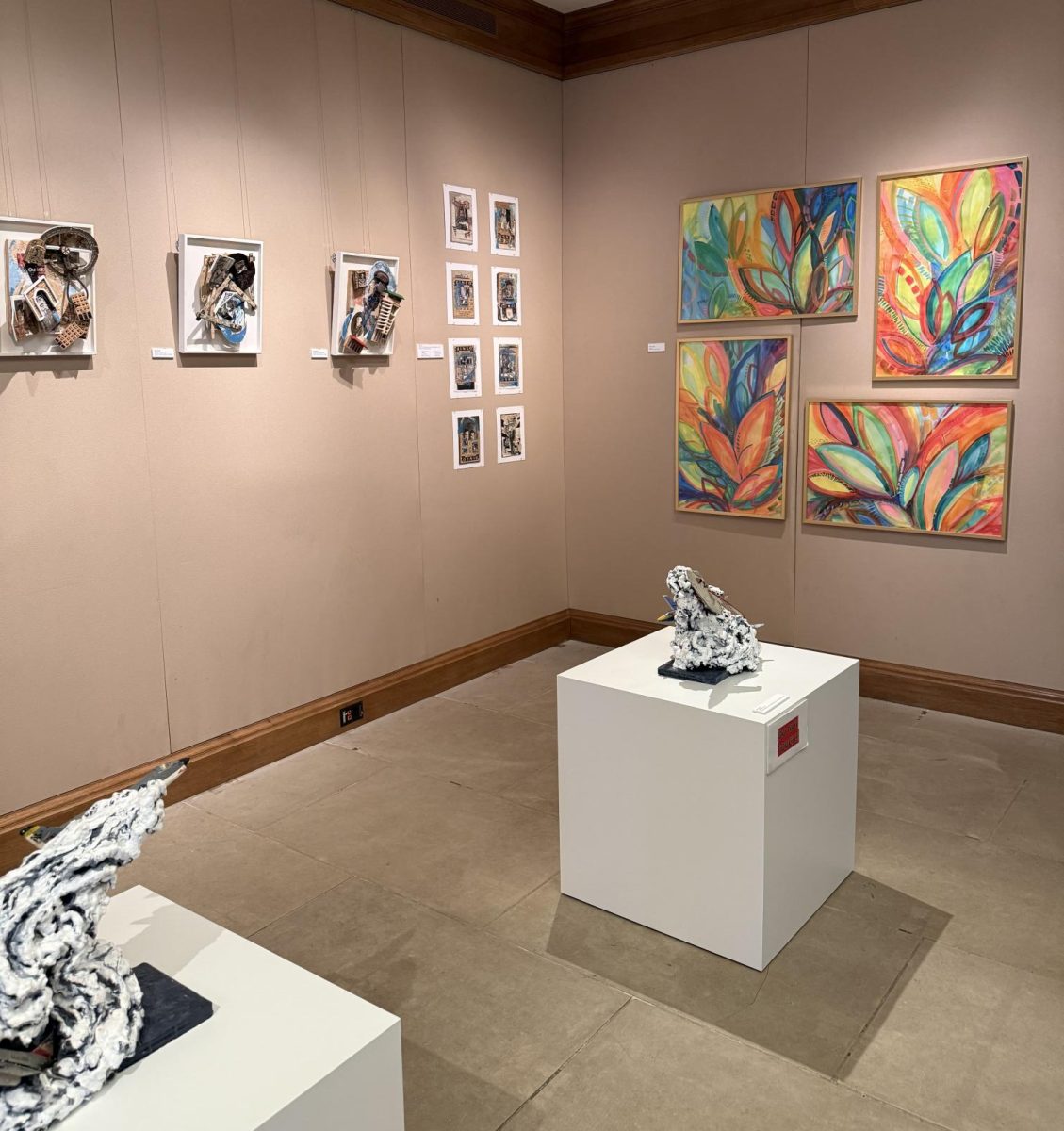
The Claire Attwell Glassell Gallery is a familiar place for student artists, where class projects are displayed for the school to see. For about a month this year, however, the names on the walls changed, showcasing work by the teachers who usually stay behind the scenes.
The annual Faculty Art Exhibition not only provided insight into the faculty’s creativity, but also into the daily lives of the adults that students see every day.
For photography teacher Dina Attar, the exhibition is a reminder that art teachers are artists first. “A lot of times, students have said ‘well, can you even draw?’ It’s good to show our students that we actually make art as well.”
Showing their own work, Attar says, allows students to see their teacher as someone who not only assigns projects, but also as people who work on “conveying emotions and thinking at a different level.”
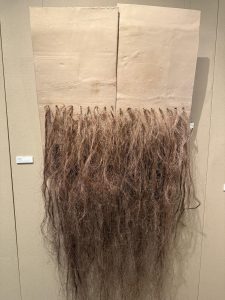
Her contribution to the exhibit ranged from darkroom film photography to a massive clay-and-fiber sculpture titled “Misaligned,” a piece rooted in a series she calls, “Do I Make You Uncomfortable?” The sculpture served as an abstract metaphor for dysfunctional relationships.
“The clay and fiber are two surfaces that are never going to align,” Attar said. “Even though you might try to force it.”
Her materials, especially clay, became deeply meaningful during the pandemic, describing how the lack of control in ceramics became a feature rather than a flaw.
Attar also wants her students to notice how different her classroom demonstrations are from her personal work.
“In class, there’s a rubric,” she said, “but outside, how we see the world isn’t always based on a rubric.”
By showing them her own abstract, conceptual pieces, Attar wants to encourage young artists to find their voice.
“Make it personal, make it powerful. The more you authentically show up, the more powerful it’s going to be.”
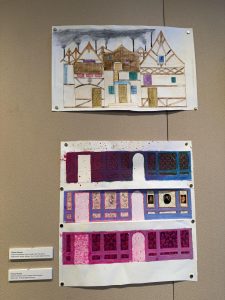
Across the gallery, the tone shifts: theater technical director Thomas Murphy filled his section with watercolor set renderings and sketches from past productions. For him, the exhibit was also a chance to see what his colleagues create on their own. Even though he works closely with the Fine Arts department, he says that he rarely sees their independent pieces.
“I thought it was a really fun idea,” Murphy said. “I like to be able to show my stuff, too.”
Murphy’s own art is rooted in storytelling and collaboration, especially with theater production directors. For his sketch of the stage he designed for the school’s production of “Pride and Prejudice,” which appeared in the gallery, he said he wanted to “give it a little bit of an edge and maybe modernize the vision.” He painted multiple concepts before narrowing them down with the show director, Jamie Stires-Hardin.
Stage design also presents a unique spatial challenge: his audience is usually over 20 feet away—much different from the scrutiny that gallery works receive.
“I’m practiced in this way of using distance as a tool,” he said, which makes his work visually different from the detail-oriented pieces typical in a gallery. “It created an interesting contrast between my work and theirs.”
Lower School visual arts teacher Carla Wall, who submitted multimedia, carvings and sculptures, said she heard about the exhibition and was interested. Wall, who has a wide-ranging artistic practice, viewed the exhibition as an important moment of visibility. It lets students see “the techniques that we have, the stories we tell,” and the ways formal training can evolve into personal expression.
Upper School art teacher Dan Havel, who helped organize the show, echoed this sentiment. When he emailed the department at the start of the year announcing the show, he hoped faculty would seize the opportunity to display their work. To him, the exhibit is not just for decoration, it serves as a teaching tool.
“When students walk by, they’re seeing the same design principles, the same concepts we talk about, but applied in our own voices,” Havel said.
For Havel, showing art publicly demonstrates that creativity is a lifelong practice, not something that disappears once a person becomes a teacher.
More importantly, he says, the exhibition invites students to imagine futures for themselves. Teachers model not only techniques but artistic identities. “If they can see us doing it,” he said, “they can imagine themselves doing it too.”