
The Oranje Fanwalk parade today created the best kind of traffic: a community-on-legs formed over two and a half miles. In just four hours, it made Houston a better version of itself.
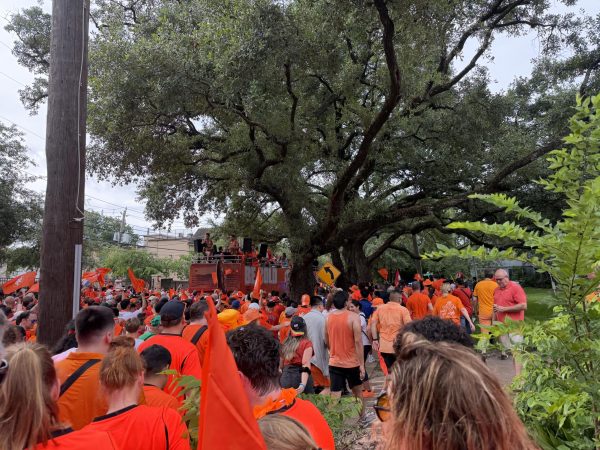
This world-famous parade celebrates the Netherlands’ national team, Oranje, en route to their World Cup matches. Orange-clad fans party while walking. I was not expecting much other than loads of litter and clogged streets, but I decided to attend just to see what all the hype was about. After all, I had never been to a parade in Houston before this one, and certainly not a parade for the World Cup.
The parade started at Rice Stadium around 8:45 a.m. I got to Rice Village on my bike about 15 minutes after the parade started. Some people in orange clothes were milling around the area, but I didn’t see anyone walking with purpose until I got to the intersection of University Street and Morningside Drive. Police cars had blocked off the street beyond Morningside Drive, Greenbriar Street, which the parade stayed on all the way to its final destination, NRG Stadium (renamed Houston Stadium for the World Cup).
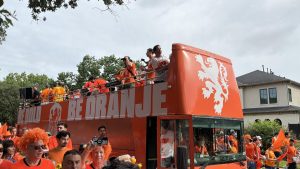
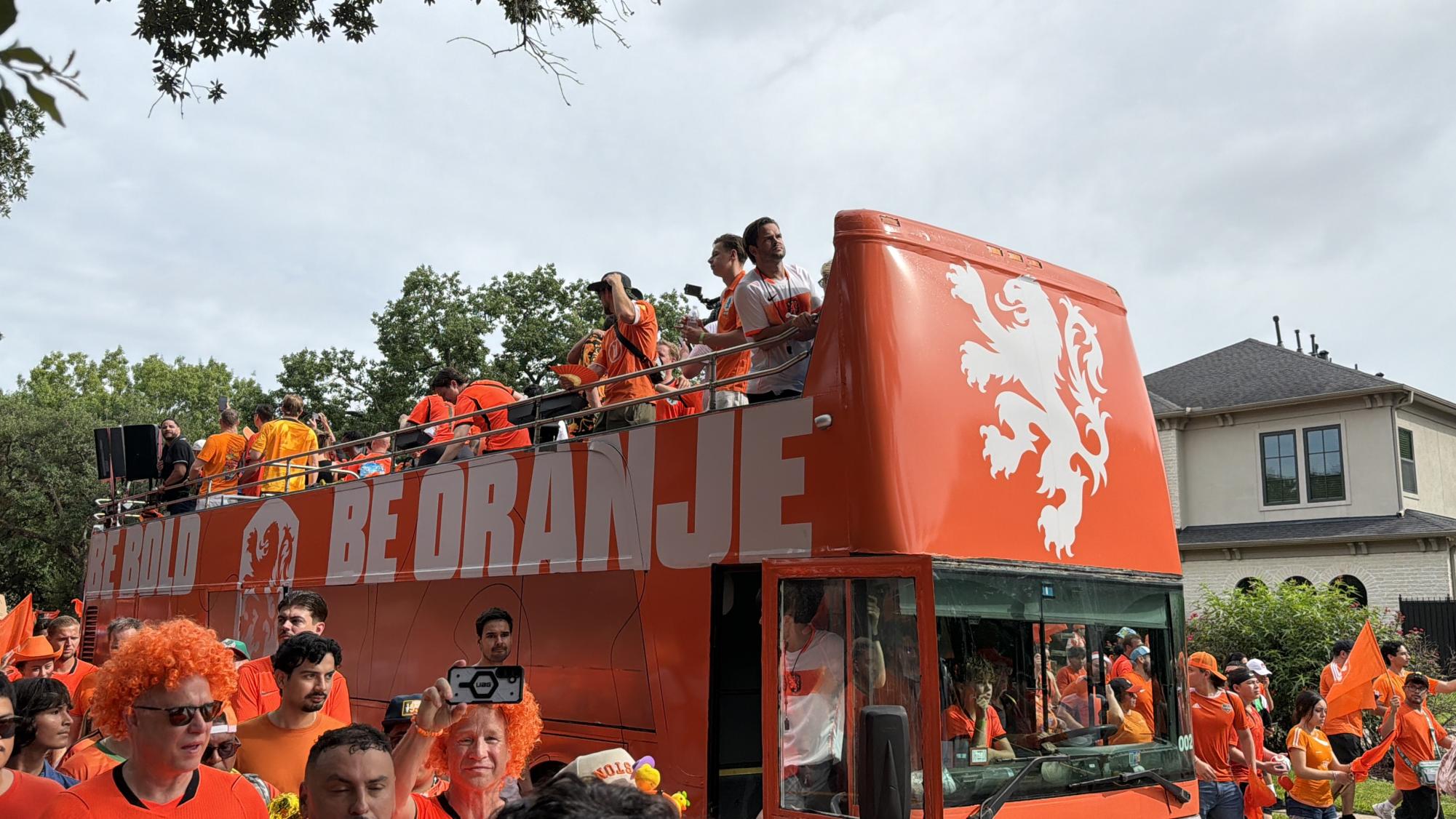
The Dutch Orange Bus was the star of the Oranje Fanwalk. A converted English double decker bus, this bus is fan-owned and has been a vital part of the Oranje Fanwalk since 2004. The rowdy, lucky fans on board sang along to the loud music blaring from the top level.
At first I stayed on Morningside Drive, parallel to the parade, only ducking into Greenbriar Street occasionally to try to catch glimpses of that viral bus. Like me, a pretty significant number of people traveled one street removed from the parade, presumably to stay out of the fray. That crowd did not look welcoming at first; it was intimidating.
There were so many people on the street, more than I had ever seen in one place in Houston. People cheered and danced to music in Dutch, English and Spanish. One fan carried the Netherlands’ flag; its flagpole emitted orange smoke which looked beautiful but smelled horrible.
I felt bad for the owners of the houses that lined the parade route. Fans stampeded over their nicely kept lawns, trampled roots and freshly cut grass, almost hitting fences in their single-minded goal to get close to the Dutch Orange Bus.
Other than thronging around the bus, marchers showed their support for the Netherlands by wearing orange. And they were creative with their outfits. I saw Astros jerseys and big orange cowboy hats. One couple wore bright, neon orange tuxedos.
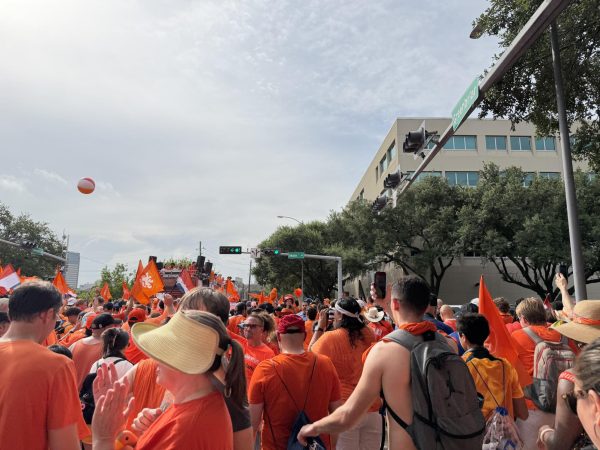
One man was quite dedicated; he wore a full, furry lion bodysuit, since Oranje’s mascot is a lion. He mostly walked around without wearing the costume’s lion head, hair plastered to his flushed face.
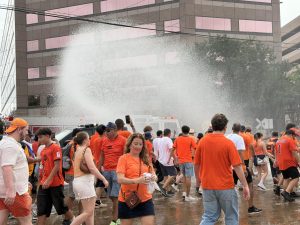
Though it was partly cloudy and around 85 degrees Fahrenheit, meaning not bad at all for a Houston summer, I’m sure the weather must have been shocking for any visitor, especially Dutch fans. In the Netherlands, June temperatures average 65 degrees Fahrenheit.
Some participants in the parade did not wear orange. They wore the green Mexico jersey. I saw enough El Tri jerseys that I thought that the upcoming match would be between the Netherlands and Mexico.
Many green-clad fans were holding signs that said “No era penal!” or “It was not a penalty!” In 2014, during a Round of 16 World Cup match between the Netherlands and Mexico, Mexican defender Rafa Márquez moved to defend Dutch winger Arjen Robben. Robben fell, and the referee called a penalty on Márquez. This call resulted in a goal kick, which the Netherlands scored, winning the game. Mexico was eliminated, and it was clear today that El Tri’s fans haven’t forgotten.
I also saw about 10 people wearing yellow and blue in support of Sweden, the Netherlands’ actual opponent for today’s game. Sweden had their own parade in Helix Park, so I do not know if the few fans I saw were confused or intent on infiltrating the orange ranks.
As the parade continued, I decided to join in, walking my bike while taking in the scene around me. Even though everyone was sweaty, no one was suffering. They were hollering or laughing or cheering, happy in the midst of their fellow fans. The crowd was not as intimidating as I thought it was at first; they were welcoming. It was the type of environment where I felt comfortable silently enjoying the parade or striking up a conversation with my fellow marchers. I did not feel pressured to go one way or the other.
Houston is a city of distance. It’s in love with cars. I’ve lived in this stubbornly un-walkable city all my life, and I’ve rarely been physically close to others on sidewalks.
It was miraculous to me that we were walking together instead of driving in this city. Everyone was so close together. The police had blockaded off the route for the seemingly neverending line of marchers, surely inconveniencing those in their cars that didn’t participate in the parade.
Well, our parade was the best kind of traffic: the traffic that brought Houston together.
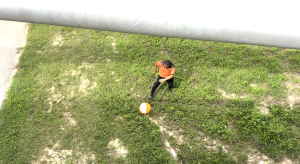
Strangers introduced themselves and shared drinks with each other. One brave person started a chant, which the marchers around him took up. Orange or orange-and-white-striped beach balls sailed above the crowd, kept up by the community.
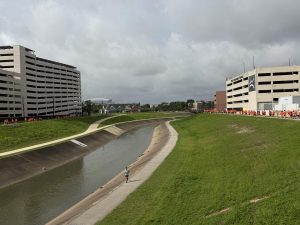
Three quarters of the way through the route, the parade crossed over Buffalo Bayou. Loud “boos” sounded through the crowd each time a beach ball drifted over the bridge’s railing. But loud cheers also erupted when someone saved a beach ball from drifting into the Bayou.
Once, when straining to hit a beach ball, a man to the side of me fell on my bike. I asked him if he was okay, and he apologized and helped me right my bike again. Another time, when I was having trouble with my bike at some point on the route, a stranger helped me maneuver it.
At the start of the parade, I was unsure whether I should have brought my bike. I barely bike in Houston because the roads are not designed to accommodate anything other than cars. When I do bike, the people in the cars behind me radiate irritation, sometimes honking or yelling. I have not truly experienced people being nice to bikers in Houston before this parade.
Overall, this parade brought out the best in Houstonians. Our parade became an elevated microcosm of our city. Kids in strollers and the elderly in wheelchairs were out in the parade today. People of different nationalities, ethnicities and team allegiances laughed with each other. Parades bring out a special sort of kindness which no one can experience ensconced in a car.
The parade ended in, fittingly, the Orange Lot at Houston Stadium. I didn’t have a ticket for the game, which started at noon, so I headed back home on surprisingly clean streets. A slight drizzle had started while the tail end of the parade got to Houston Stadium, but it did not kill the mood.
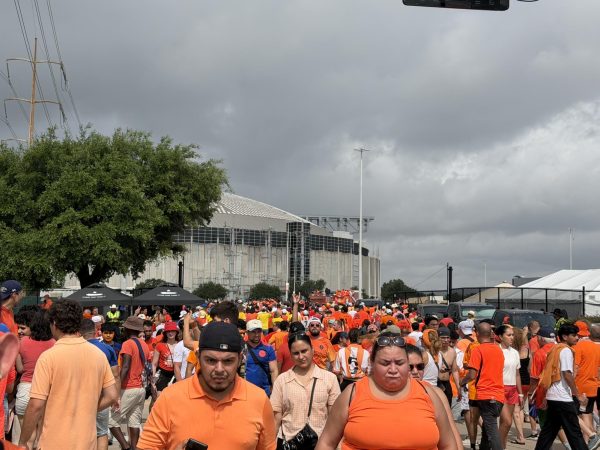
Parades—walks in the sweltering sun that takes hours to travel what can be driven in minutes—should be unattractive for Houstonians. Yet thousands of people showed up for the Oranje Fanwalk. Though it was in celebration of another country, it brought Houston together. It was an exhilarating experience, a bonding opportunity that magnified the best parts of being human for everyone in the parade. It proved to me that being in a parade is a chance for connection that no Houstonian should miss out on. Get out from behind the wheel and stretch your legs!
The Netherlands beat Sweden 5-1 today. Take part in a parade, and you’ll feel equally victorious.