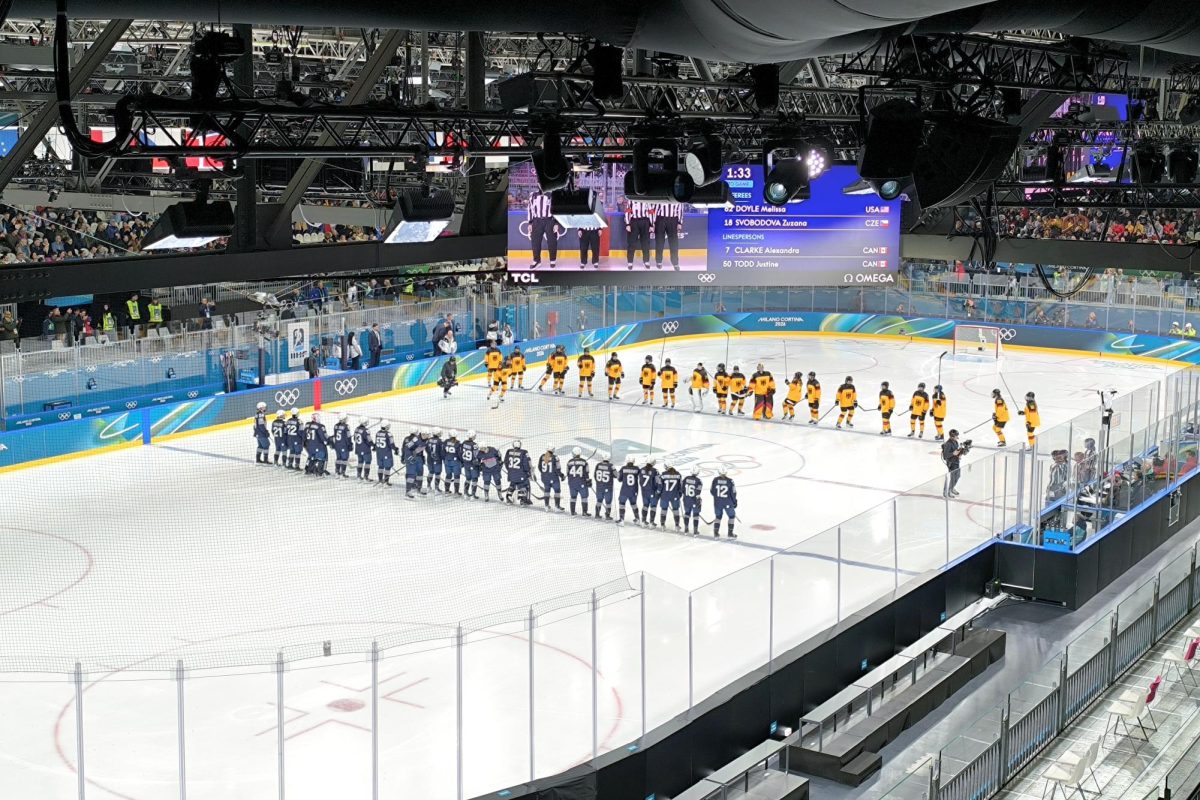
Since the 1980 Winter Olympics, the gold medal for men’s hockey has been just barely out of reach for the United States. Last month, New Jersey Devils NHL player Jack Hughes ended the team’s 40-year drought when he fired the puck past Canada goaltender Jordan Binnington, scoring the game-winner in overtime.
This win was pure, sweet revenge for the United States. It healed the wound that had been open since Sidney Crosby scored a legendary Canadian goal in the 2010 Olympics, which shattered American hockey fans’ dreams of Olympic Gold.
Honestly, I wasn’t rooting for the United States going into the Olympics since they cut and benched my favorite players, Jason Robertson and Jake Oettinger. Instead, I rooted for Finland.
But this game sparked something inside of me. While I wasn’t happy with the 7 a.m. start time on a Saturday, and for the sixth straight time, my beloved goalie Jake Oettinger wasn’t starting.
This game will go down as one of the most memorable hockey moments that I have ever witnessed. And I, alongside other United States hockey fans, will remember this game for the rest of my life.
Going into these Olympics, I was skeptical of the slow, methodical play style that international hockey is synonymous with. The rink the teams would play on was only ready about a week and a half before the games would begin, and the intense competition between NHL players from the US, Canada, Finland and Sweden that was achieved at the Four Nations Face-off from a year prior would be extremely hard to replicate.
But the Olympics exceeded my expectations, building onto the unprecedented success generated by the Four Nations Face Off.
The storyline that has risen above the rest was the legendary matchup between the United States and Canada.
As a decade-long hockey fan, I hate Canada. The rivalry between the US and Canada is second only to none other than Sweden and Finland. Watching this in my living room, it was not just about the gold medal anymore; both dignity and national pride were on the line.
Combining the emotional baggage invested into the US vs Canada game and some of the best hockey players, you get one of the most memorable Olympic hockey games of all time.
The Jack Hughes goal was legendary, but none of this would have been possible without Winnipeg Jets Goaltender Connor Hellebuyck. There have been insane goalie performances comparable to that of Hellebuyck in both the NHL and other international tournaments. But what Hellebuyck did, stopping 41 of 42 shots for an insane .976 save percentage(any save percentage above .900 is considered good, and anything above .920 is elite), is nothing short of legendary. Hellebuyck’s play was so incredible that he has now been awarded the Presidential Medal of Freedom, becoming the first hockey player to receive the honor and joining athletes such as Simone Biles, Muhammad Ali and Michael Jordan.
This season in the NHL, Hellebuyck has been one of the most disappointing goalies. Just a season prior he won his second consecutive Vezina trophy (Goalie of the year), and became the first goalie in ten years to win the Hart trophy (NHL MVP). This season however he has posted mediocre stats and as a result the Jets are likely not going to make the playoffs.
And the Jets are in the same division as the Stars, so there is a twinge of bias, but Hellebuyck, in recent years, has made a name for himself as a player who crumbles during the playoffs and lets his team down as a result. But any doubts about Hellebuyck’s big game ability have been completely squashed, and his legacy has been cemented.
For the first time in a while, NHL superstars are becoming household names. Jack Hughes, who is only 24 and has probably over a decade left in his career, has cemented his legacy as a USA hockey legend.
One of my favorite moments after the United States captured gold was the team honoring player Johnny Gaudreau, who tragically passed away in August 2024. Nicknamed Johnny Hockey, Gaudreau was a prominent figure in USA hockey and the NHL who undoubtedly would have had a spot on the men’s hockey roster if he were still alive today. His passing was absolutely heartbreaking, but through the efforts of all his former teammates and the NHL, his legacy and memory have been preserved.
The women’s team also clinched gold for the US two days prior, winning 2-1 with forward Hilary Knight scoring the overtime winner. This is the first time that the United States won gold in both divisions at the same Olympics.
Unfortunately, the triumph following the wins were brief. In a post-game celebration, the team received a call with President Trump where he commented on being “forced” to invite the women’s Olympic hockey team to the White House at the risk of impeachment. The United States players were fairly intoxicated at the time and impudently laughed at this sexist, horrible excuse for a joke. In response, the women’s team declined Trump’s invitation.
Hockey is in desperate need of an image change, but all of hockey’s problems with racism, sexism and elitism were broadcast to the world through Trump’s comment. It sets hockey back, leaving a bad taste in my mouth. It angers me that this controversy has almost overshadowed the accomplishments of the women’s team and negatively impacted the image of the men’s team.
Despite the controversy and hard feelings, the Olympics have increased visibility for the sport. I have seen more people take an interest in hockey following the success of the Four Nations Face-Off and the pop culture impact of the series “Heated Rivalry.” The Olympics were the cherry on top.
All I ask is that NHL commissioner Gary Bettman and the NHL build off this success. Through all the controversy, patriotism and national hockey heartbreak, the 2026 Winter Olympics will leave a lasting impact for years to come.