
Upper School French teacher Elizabeth Willcutt is known for locking late students outside her classroom at the start of the carrier. On the third day of school, Upper School math teacher Bethany Goldman became the first tardy student of the year.
“It was so embarrassing, and since then, I have had this deep motivation to get there early. It’s a pretty effective thing that she does,” Goldman said.
Goldman, who teaches math, spent a summer in France under the faculty Sarah Rabinow Pesikoff grant, which funds enrichment opportunities for full-time faculty who have served SJS for 10 or more years. After returning home, Goldman wanted to continue improving her French, so she began regularly attending Willcutt’s French III class as an 18th student.
As part of their professional development, faculty are all required to observe another teacher at least twice throughout the school year. Now, Goldman is observing and participating every single day.
“It’s given me a total student perspective. I’m always like, ‘Oh no, I forgot to check the website for homework,’’ Goldman said.
Like the rest of the students, Goldman takes assessments—and fights for first place in Kahoot and Quizlet Live.
“I’m trying so hard to win, and I often don’t win. I have one or two people in the class who are my nemeses because they always win,” Goldman said.
After one particularly taxing French Kahoot game, sophomore Angela Mu celebrated when she finally secured her first-place spot. Yet she soon realized the controversy of her victory. According to Mu, Goldman, who was sitting behind her, fixated an irked stare so intense on her that Mu felt a “hole being drilled” in the back of her head.
“Sometimes after a Kahoot game, when she passes me, she’ll side-eye me,” Mu said.
For Goldman, auditing as a student has also inspired her to incorporate certain elements from Willcutt’s class into her own—even across disciplines. She normally assigns seats on the first day of school and does not change them throughout the year, yet she has found that Willcutt changes them around every month.
Last school year, Upper School Spanish teacher Angela Prendes began the “trend” by taking French II with Upper School French teacher Shelley Stein (‘88). She moved on to Stein’s post-AP seminar in French this academic year, skipping AP French Language and Culture.
“I’ve developed a greater sense of empathy for my students,” Prendes said. “You realize what it is to freeze mid-sentence, what it is to communicate in a broken language because you don’t have the skills to exactly communicate what you want to say or how exhausting it is.”
According to Willcutt, the addition of a teacher to the classroom also creates a “different dynamic.”
“When students saw a teacher making mistakes, asking questions and taking risks alongside them, it helped take the pressure off,” Willcutt said. “Students were more willing to speak up, try more challenging language and share ideas without worrying about getting everything right.”
Out of any learning environment, Willcutt considers the academic sphere to be the most beneficial for language learners.
“If you’re only attending a class once a week out in the community, those concrete expectations aren’t in place,” Willcutt said. “Just being in a school means that students have the everyday expectation of what that teacher wants.”
Additionally, having Goldman in her class has also encouraged Willcutt to consider auditing in other classes in the future, as Willcutt recognizes the benefits of learning from instructors who teach differently than she does.
“I just wish more people would be open to the experience because I’ve seen so much growth in teachers who have audited not only their skillset, but also their engagement with the community and with us as faculty members,” Willcutt said. “So I think we could all really benefit from having more professional development in the sense of being a student.”
When Upper School Math teacher Alice Fogler (‘10) heard of the possibility of teaching for a year at the School Year Abroad Program in Rennes, France, she immediately replied that she was “definitely interested.” Fogler was even more excited when the program had an opening in France.
“Paris is one of my favorite cities in the world. It’s where I studied abroad,” Fogler said. “The opportunity to live in France again was very enticing.”
Even though Fogler took French as a student at the School, Fogler hasn’t formally studied the language in 17 years. So, after hearing Prendes talk about her experience auditing Shelley Stein’s French II class, Fogler made up her mind to join Stein’s French II.
“It has given me an outlet where I can speak more confidently because it’s in a classroom setting,” Fogler said. “It has made me realize I understand more than I think.”
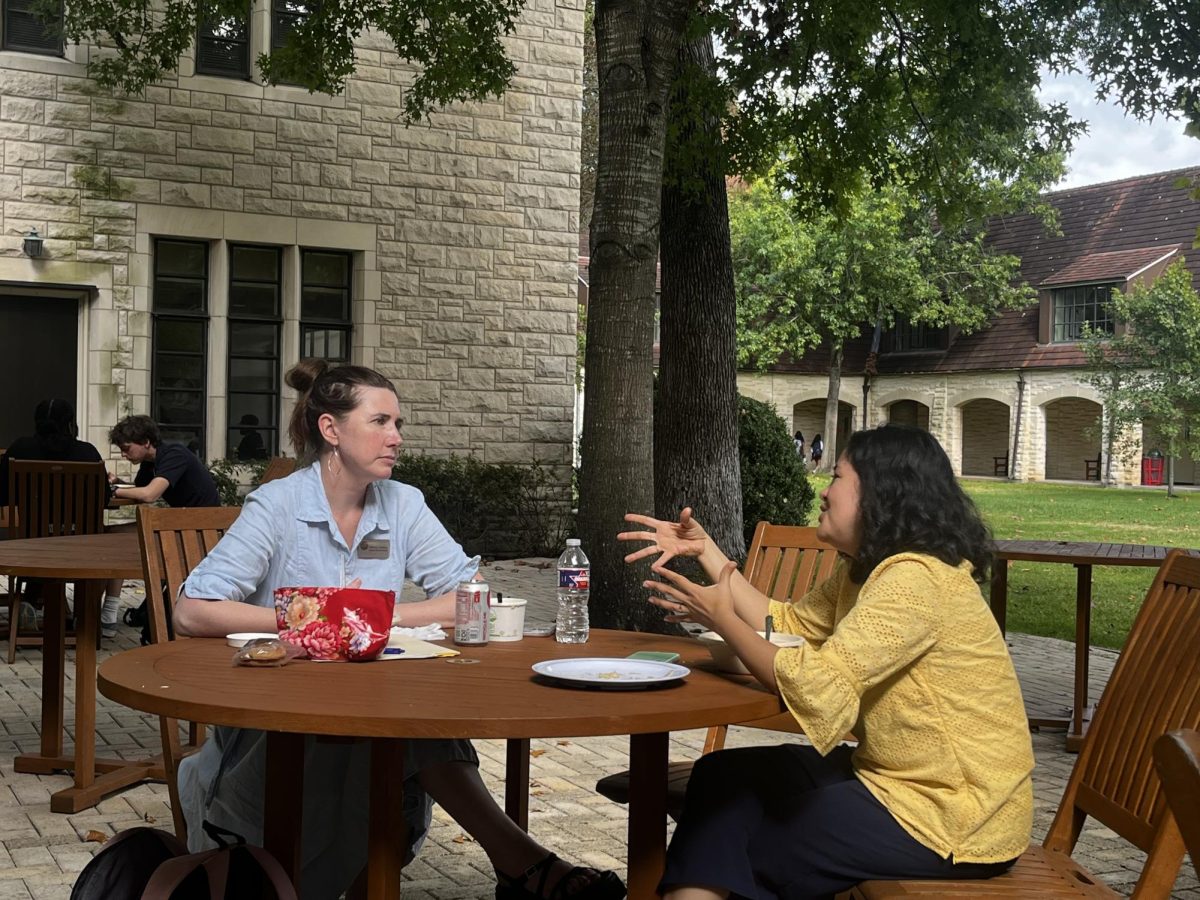
To further improve their French, every Day 5 during lunch, Goldman, Prendes and Fogler participate in a French Circle led by Stein and Willcutt. During the French Circle, conversations are all in French.
Goldman says she cannot always participate as fully in the French Circle’s discussions as much as she wants to, but according to her, it is “a good opportunity” to practice new words and phrases.
“I get to know other colleagues because I don’t interact so much with the math teachers,” Prendes said. “So it is also a good way for me to get to know Ms. Goldman and Ms. Fogler.”
Teacher auditing has not only contributed to teachers’ growth in understanding and passion for French, but it has also opened an opportunity for them to be immersed in the same environment that their students experience every day.
“It’s really given me just more empathy,” Goldman said. “Now I know exactly how it feels when you walk into the classroom to take a quiz.”