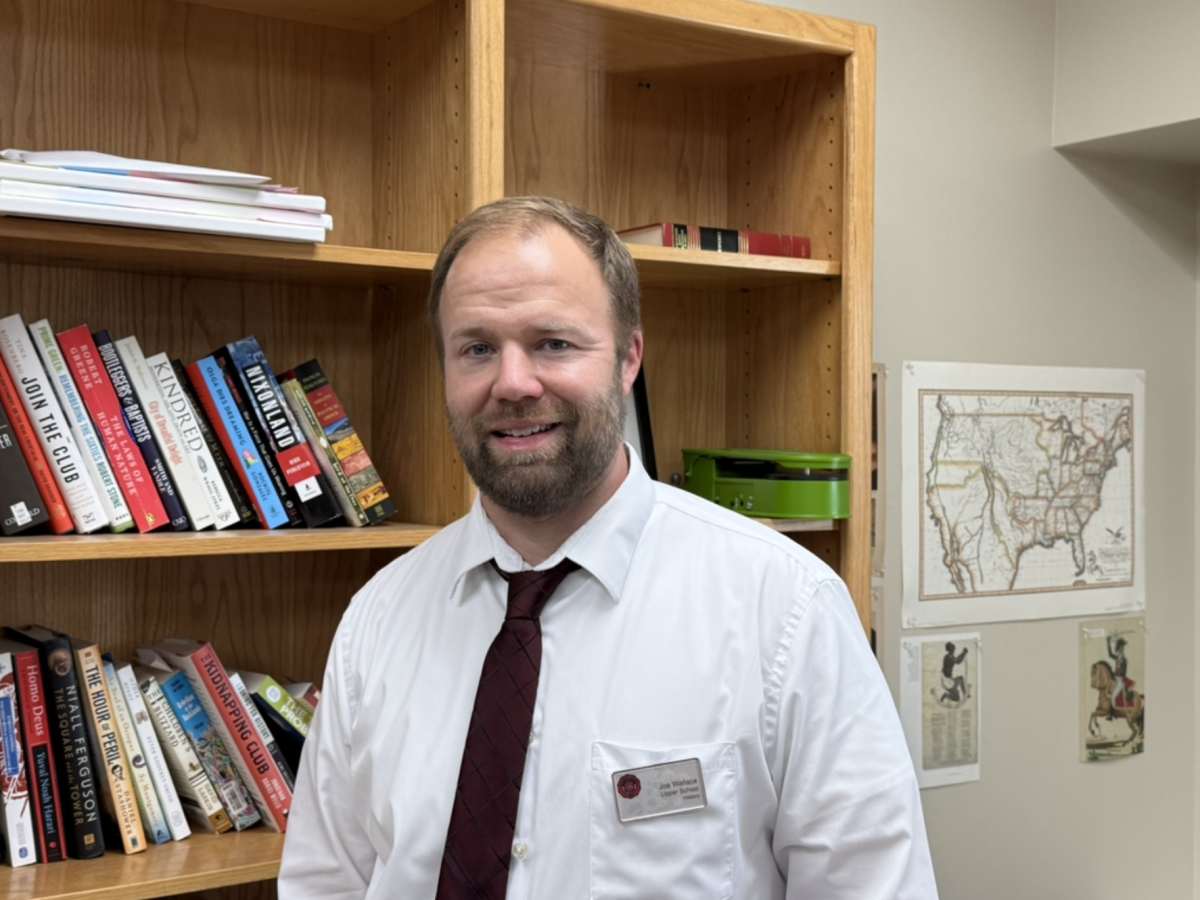
After three months of searching, Upper School history teacher Joe Wallace finally found a space to concentrate on writing his dissertation. Yet almost immediately, his work was interrupted by an explosion that blew up an entire city block in Nashville.
During the pandemic in early 2020, Wallace and his wife were living in Nashville to be closer to family. Wallace was three years into writing his dissertation and found that he could not do any work at home. So, Wallace decided to rent an office space through WeWork, a company offering social-distanced office spaces in downtown Nashville.
He settled into a familiar routine—until early Christmas morning 2020, when a 63-year old man blew up a recreational vehicle a few blocks from Wallace’s office.
Although the WeWork building was not destroyed, the office space shut down for two weeks.
Wallace took this as a sign. “The universe was telling me not to write, to just be with family and enjoy the holidays,” Wallace said. “And sometimes that’s okay. It’s important to compartmentalize and give yourself time off.”
Inspired by the financial crisis of 2008 and historian Bruce Mann’s book The Republic of Debtors, Wallace is writing a dissertation about finance in America between the American Revolution and the Jacksonian period at Johns Hopkins University. He was accepted into their graduate program in 2015, finished his coursework in 2017 and has been researching and writing his dissertation ever since.
Wallace jokes, “This is the longest homework project anyone has had, ever.”
Wallace is used to homework; he already has three graduate degrees. Wallace went straight to law school after attending the University of Mississippi and practiced in Mississippi and Tennessee. He decided to stop being a general practice lawyer, though, because he was bored.
“Everybody thinks of law as the television stuff where you’re gonna have a death penalty case. You do have some exciting stuff come along, but eventually, if you do general practice, it gets to be a little bit more like carpentry,” he said. “There’s not much creativity involved.”
Though Wallace did work in courtrooms frequently, his other tasks involved drafting legal documents, copy-and-paste work. Motivated by love for challenges and the classroom, he pivoted to an educational career in 2013. Wallace obtained a Master’s in Curriculum and Instruction through the Mississippi Teacher Corps in 2015 and a Master’s in History from Johns Hopkins in 2017, then immediately started on his PhD.
“As a teacher, researcher and writer, I’m doing exactly what I love,” he said.
One of Wallace’s favorite parts of research has been visiting the archives. He has researched in places including New York, Washington D.C., Michigan and London. Though he is wrapping up his dissertation, he reflects on his time among manuscripts fondly.
“I spent a lot of time decoding old, old cursive from the 1700s and 1800s,” he said. “There’s nothing like opening an old book when it still smells like tobacco or coffee.”
Other than the explosion, one of Wallace’s main challenges in writing the dissertation has been balancing teaching responsibilities with doctoral duties. Wallace came to St. John’s in 2021.
“At a competitive school like this, the teachers have to be very, very good, and they need to learn on the job,” Wallace said. “In my first two years here, I probably didn’t do much writing at all. I put it on the back burner.”
As time passed, Wallace has gotten used to the rhythms of teaching and research. To maximize his productivity, Wallace sometimes arrives on campus at 6:00 a.m. to work.
“I’ve stolen a little bit of time away for myself in the early morning,” Wallace said. “I can justify that—because no one’s awake anyway.”
Wallace projects that his dissertation will total at approximately 300 pages. He will finish it in 2026, and aims to publish it as a book one day. He is grateful for the stages of his life that have intertwined together.
“I’m much more mature, and the writing I’m doing now is the best writing I’ve ever done. I know my way around writing from grading for so many years,” Wallace said. “They take good care of teachers and have really bright students here, so it’s a great place to work and be a professional scholar in a different way.”