
Scattered across campus during any free period, dozens of students can be found focusing on one thing: their phone.
In May 2025, the Texas legislature passed House Bill 1481, which prohibits personal communication devices during the school day at all public schools.
Head of Upper School Kevin Weatherill was deeply involved in the implementation of the School’s new policy.
“As an independent school, we have a different relationship with state legislation compared to public schools. However, our policy addresses a concern that every school has, regardless of their affiliation,” Weatherill said.
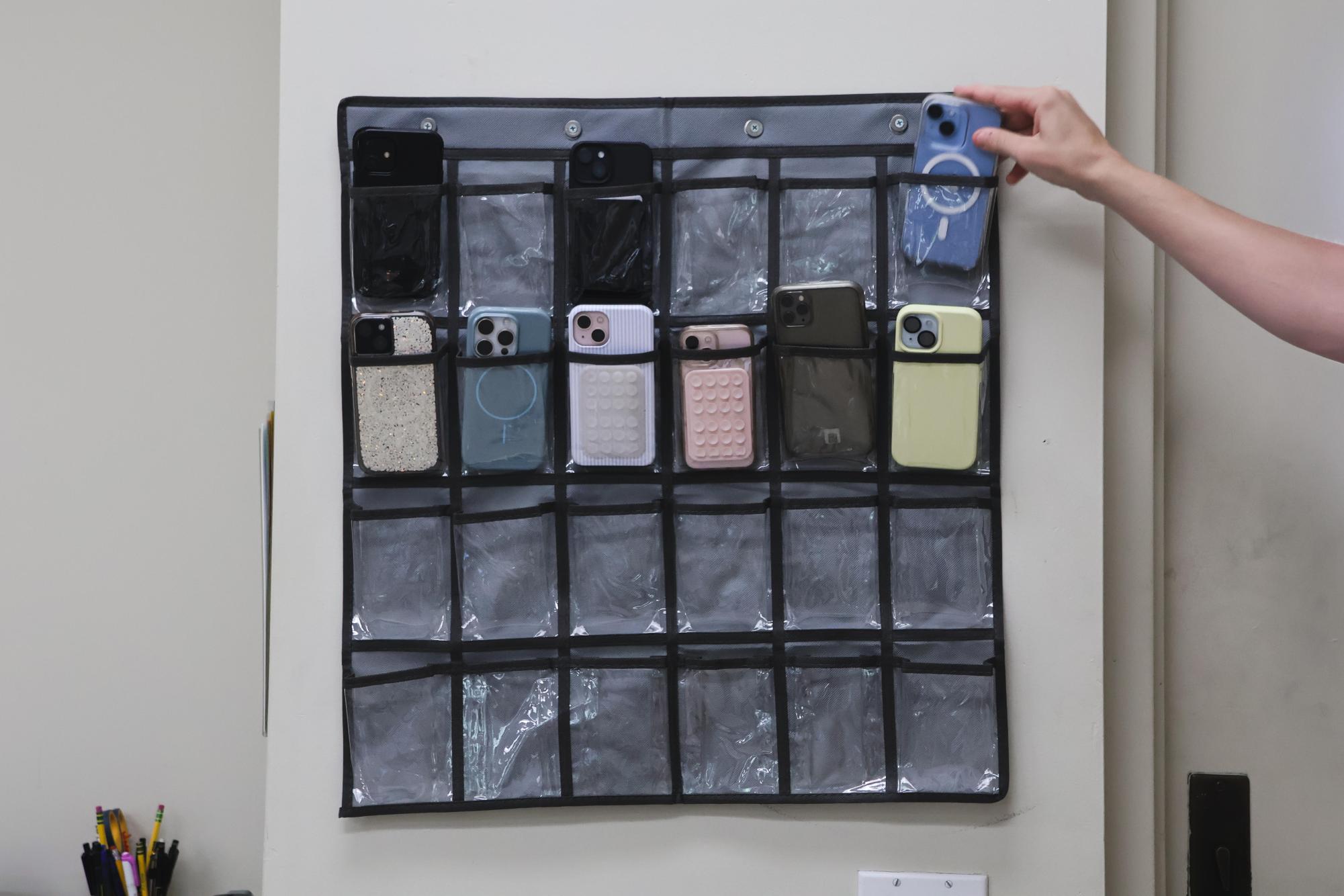
Despite this, students and teachers alike have begun to notice changes in the way phone usage is regulated. Starting this school year, the School introduced a new policy which limits phone use during in-class hours. During class time, all phones must be placed in the caddies on the wall until the end of the period.
Since mobile phones first became widespread in the early 2010s, addiction has become increasingly prevalent. Sophomore Jake Irwin is one of many students who considers himself addicted to his phone.
“I just reach for it too much,” Irwin said. “I use it for lots of things, so I’m just used to it.”
App developers continue to add features that attract users, causing them to lose hours scrolling, engrossed in videos, images, sounds and games. Even the music app Spotify recently added a feature allowing users to endlessly scroll through short videos accompanied with music.
Math teacher Caroline Kerr (‘01) has watched the evolution of smartphones from useful tools to distraction machines.
“Ten years ago smartphones weren’t as constant of a distraction as they have become,” Kerr said. “People have their phones out all the time, even things like taking pictures of notes instead of just writing them down has become a new trend.”
Reactions to the new policy have been mixed, with teachers and students all having different views.
“It’s a really good thing overall,” Upper School history teacher Callie Carnahan said. “To have your phone, even just in the vicinity, distorts your ability to focus, even if you’re not actually on it.”
Carnahan recalls learning about the harmful effects of phones from reading teen psychology books in her free time. She found that a solely in-class ban may be even worse for students, as phones still get in the way of adequate socialization.
“I’m not fully opposed to an all out ban, but even that may lead to tricky situations” Carnahan said. “Phones are an easy out when you’re in a tricky social situation and those are the kind of things you need to build those muscles on, especially when you’re a teen.”
Weatherill says that the primary focus of learning is to promote in-class concentration. “I certainly encourage students to put down their phones and have face-to-face conversations during lunch and DaVinci periods, but our goal is to prioritize students’ attention in class.”
While some teachers view this phone ban as a weak, even harmful way to restrict phone access, others express the importance of learning restraint and self control, qualities needed in the real world.
“We’re trying to prepare students to be adults where they are expected to manage your phone. So, some level of access is okay and may be necessary,” Kerr said.
Additionally, some students view this policy as a potential hazard. They worry that not having access to phones in case of an emergency could lead to dangerous outcomes.
Sophomore Mason Knupp worries about the implications of not having access to a phone. “It would be a little bit dangerous not to have a phone in situations where it would be really helpful to call someone for help,” Knupp said.
Further, he also shares Kerr’s thoughts regarding self discipline.
“It’s useful for us to learn time management skills rather than them being forced upon us.”
Weatherill also notes the complications that would arise when trying to manage hundreds of phones each day.
“When you consider a policy that involves policing outside of class, an adult has to do that, and that’s time they’re not doing something else like grading tests or providing office hours,” Weatherill said.
Regardless, students and teachers have begun to adopt new methods to improve their phone habits.
“I just had to delete TikTok a couple years ago because I found it was just too addictive,” Carnahan said. “I only do social media in grey scale, and that takes a lot of the fun out of it.”
More broadly, interest in curbing phone addiction has risen since the COVID-19 pandemic locked many inside without much else to do. Apps such as Dumb Phone and Opal, which restrict phone usage by blocking distracting apps and minimizing displays, have seen meteoric rise in downloads as students and professionals alike grapple with time management.
Carnahan looks at the whole situation with optimism.
“In a world becoming increasingly digital, it’s good that our school is putting emphasis on navigating phone usage.”